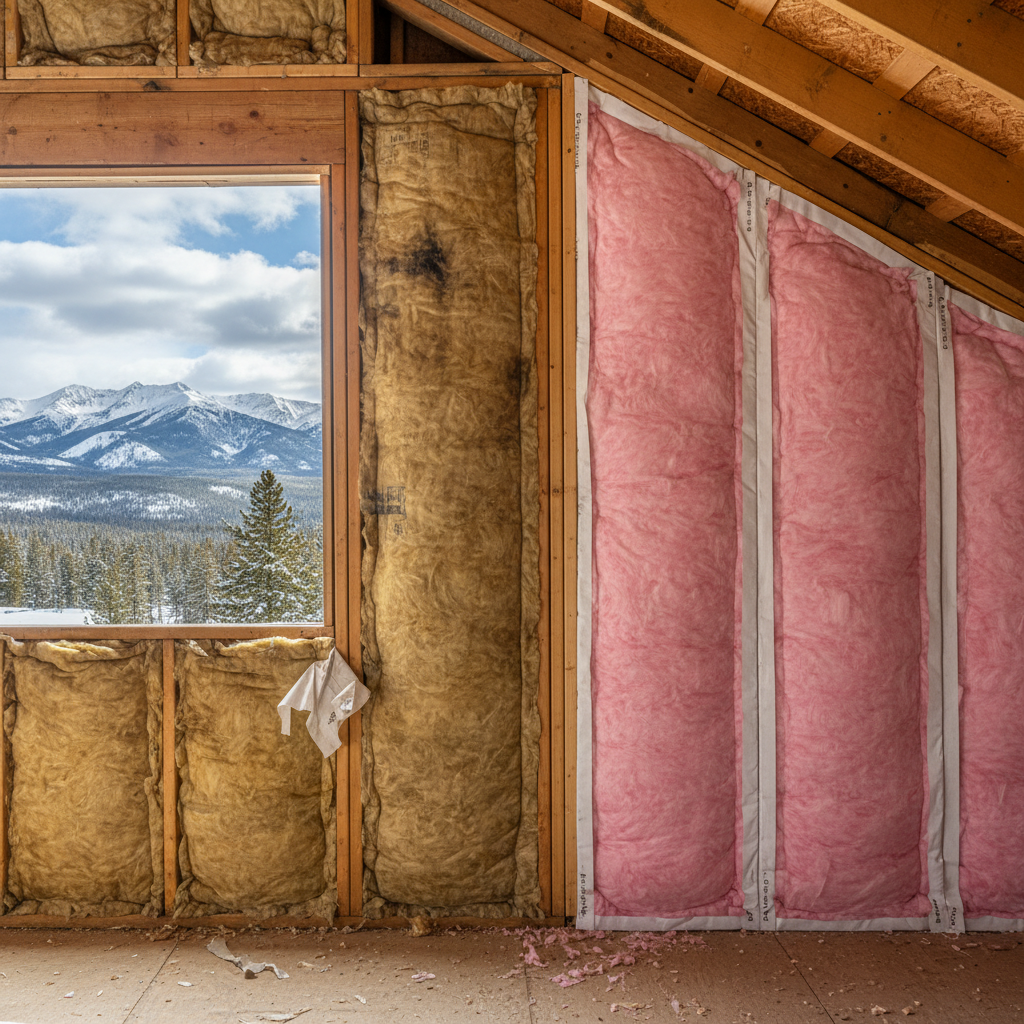
Alright, let us talk about Insulation. You are looking at Batt Insulation, which is a solid choice for many Big Sky homes. This is especially true when you are working with standard wall cavities, attics, and floor joists. Batt Insulation is very good at stopping heat transfer and making your place more energy efficient. But then you hit the question: faced or unfaced Batt Insulation? It is not just a minor detail; it is important for getting the performance you need, especially with our temperature changes here in Big Sky, Montana.
What is the Deal with Faced Batt Insulation versus Unfaced Batt Insulation?
The main difference between Faced Batt Insulation and Unfaced Batt Insulation comes down to a vapor retarder. Faced Batt Insulation has a paper, foil, or plastic layer attached to one side. This layer is designed to slow down moisture movement through your walls. Unfaced Batt Insulation is just the raw material. This material can be fiberglass, mineral wool, or cellulose. It does not have that backing. Think of it this way: the facing on Faced Batt Insulation is like a specialized shield against moisture.
Faced Batt Insulation: The Moisture Manager
Faced Batt Insulation typically comes with a kraft paper, foil, or plastic backing. This backing acts as a vapor retarder. This is important for controlling moisture. Moisture is a big deal in cold climates like Big Sky, Montana. In these cold climates, warm, humid indoor air can condense against colder exterior surfaces. When you are installing Faced Batt Insulation, that facing usually goes towards the warm side of the wall. So, it faces inside your living space during the winter months.
- Installation: Faced Batt Insulation is often easier to install. The facing holds the Batt Insulation together, making it less prone to tearing. Some Faced Batt Insulation even has staple tabs to secure it to studs. You can also friction-fit Faced Batt Insulation.
- Moisture Control: This is the main benefit of Faced Batt Insulation. The vapor retarder helps prevent moisture from getting trapped in your walls. Trapped moisture can lead to mold and structural damage in your Big Sky home.
- Cost: Generally, Faced Batt Insulation costs a bit more. It can be about 10-15% higher than Unfaced Batt Insulation.
- Appearance: Once Faced Batt Insulation is installed and covered by drywall, you will not see it. So, appearance is not really a factor here.
- Durability & Maintenance: Fiberglass Batt Insulation, whether faced or unfaced, generally lasts 15 to 20 years. After this time, its effectiveness might decline due to settling or moisture. Proper installation of Batt Insulation is important for its longevity.
Unfaced Batt Insulation: The Flexible Option
Unfaced Batt Insulation does not have that vapor retarder. It is just the Insulation material itself. This means Unfaced Batt Insulation relies on other layers in your wall assembly to handle moisture control.
- Installation: Unfaced Batt Insulation is typically friction-fit between studs, joists, or rafters. It needs to fit snugly to stay in place. You have to be careful not to compress Unfaced Batt Insulation, because that reduces its R-value.
- Moisture Control: Since there is no built-in vapor retarder, Unfaced Batt Insulation is used where a vapor barrier already exists. It is also used where a vapor barrier is not needed. For example, you would use Unfaced Batt Insulation for interior walls for sound dampening. Or, you would use Unfaced Batt Insulation if you are adding Insulation on top of existing Faced Batt Insulation in an attic. This helps to avoid trapping moisture.
- Cost: Unfaced Batt Insulation is usually a bit cheaper upfront than Faced Batt Insulation.
- Appearance: Like Faced Batt Insulation, Unfaced Batt Insulation is hidden behind walls. So, there are no aesthetic concerns.
- Durability & Maintenance: Unfaced Batt Insulation has a similar lifespan to Faced Batt Insulation. However, its performance is even more dependent on the overall wall system's moisture management. If moisture gets in, Unfaced Batt Insulation can lose its effectiveness.
Which One for Big Sky, MT?
Given our cold, dry winters in Big Sky, and the potential for moisture issues if not handled correctly, Faced Batt Insulation is generally your best bet for exterior walls and attic ceilings in Big Sky. The vapor retarder helps manage that important moisture movement. This movement goes from your warm indoor air to the colder outside air. Installing Faced Batt Insulation correctly, with the facing towards the heated interior, is important.
However, there are specific situations where Unfaced Batt Insulation is the right call for Big Sky homes:
- Interior Walls: For soundproofing between rooms, Unfaced Batt Insulation is perfect. You do not need vapor control in these walls.
- Adding to Existing Insulation: If you are topping up Insulation in your attic that already has a faced layer, always use Unfaced Batt Insulation on top. Putting Faced Batt Insulation over Faced Batt Insulation creates a second vapor barrier. This can trap moisture between the two layers of Insulation.